Monday, April 21, 2014

Culture, Communication and Media Reflection

     The evolution of media has made a massive impact on our society, culture, and human race in its entirety. This impact has effected almost every aspect of our lives from our careers, to our daily lives, to almost all our interactions and so much more. The intensity of media has brought about a ton of new norms for our culture that continue to grow and change daily. What the media has not brought yet but will eventually bring is social change and discovering how to evolve with the technology. The democratization of our society has brought about a lot of good changes which keeps increasing but technology has out run us. Ultimately, technology and the media are a few steps ahead of our mass culture. The mass media is developing so quickly and it is so exciting but we have not yet found a way to uphold our values in such an overwhelming state of media. Overall, the massive changes that have occurred have been positive. We just have to learn to live in a society where technology and media are so prevalent in the ways we interact. We have to learn to change the way we portray our morals and ethics as individuals and as culture before we will be able to appreciate the way media has shaped us.

     Democratization has made numerous amazing things possible in our lives. Most importantly, communication is easier than ever before. We have a bunch of different ways to interact with a bunch of different people that would never be possible without technology and the media. It has opened up so many doors for people to experience their passions, explore new ideas, and learn things that the mass culture has never been able to access before. Culture and Communication Part I introduces this concept. "In early times there were distinct differences between culture of  the elite...  and the culture of  the common person... Although some elite culture  exists today, ordinary people can at least observe some of  it on TV shows..." The gap between  the "elite" culture and the "common" culture is closing. Most people have  access to internet, transportation, and leisure activities. While there are variations of this things and different costs, the majority of people can afford these things in one form or another. Democratization occurs in several different aspects of our society however, a great example of it is the media. Now, way more people have the ability to  put themselves out there and get noticed. In Press Pause Play numerous artists agree with this idea. Hank Shocklee says, "A lot of movies that may have not had the chance to be made will be made, which means you're gonna have a lot more options for cinema, you're gonna have a lot more creativity rising to the top." Shocklee refers to this concept with cinema but it is true with so many things now that the internet plays such a  huge role in our lives. It is so simple to but creative ideas out there, on websites, blogs, social networks, youtube and so many more internet creations. If someone has talent, they can build a fan base and get noticed. A good example of this is Lena Dunham who was featured in Press Pause Play as well due to her acting career. She says, "I never thought of film making as a job I could have... it didn't ever occur to me that it was something I could do with my life." Although many people don't see themselves as ever being able to become rich and famous it is now possible for the "average Joe". If someone demonstrates their talent in a YouTube video, the whole world can watch along. It isn't hard to get ideas out there and therefore it makes it much easier to make connections. Someone can watch one video of someone singing and share it on their Facebook page. Then someone else sees it and  posts it to their blog. Then a friend of theirs sees it and they have a friend in the music business who they email it to. There are hundreds of ways for information to reach the world and tons of ways to let new talents surface. 

      The growth of the media was inevitable and its influence is huge in our society. Every where we go we are exposed to an advertisement, television, music, art, etc and by now we are used to that. People often associate many societal issues with the media and technology, however all of our issues stem from within ourselves. Some people believe that society has become a less trusting, less giving place because of technology, they think it has isolated us a little bit. For example, in Culture and Communication Part II, there is a quote from a sociologist named Louis Wirth. During his time he felt like the new societal changes were negative. "...the new urban culture... saw 'the weakening of  bonds of  kinship and the declining social significance of the family, the disappearance of the neighborhood, and the undermining of the traditional basis of social solidarity.'" Parts of this are true. Our social relationships have changed a lot and as a society we are learning how to develop the skills to communicate through technology as well as in face-to-face conversations. But, we are not losing the sense of family or community. Family and friendships are still incredibly important to us. Technology is too. We are having a hard time finding a way to have all this distraction in our lives and still be able to sit down and just be physically there with other people although we still value this time very highly. Even though a lot of times we cannot sit down and be with others physically without being with others also through technology. Joseph Garner from the documentary Craigslist Joe demonstrates how community is still very much alive in our society. Garner says, "As a country we're wealthy, diverse, and technologically sophisticated yet some say we have lost the sense of community that used to carry us through tough times. Today it is every person for themselves. Some say technology and social media fuel this isolation." Through his experiment, Garner was able to prove that if we use technology in the right ways it actually increases the sense of community. People are still generous and people do care about interacting with others. In the lecture, The Empathic Civilisation, done by Jeremy Rifkin he explains how we are capable of this. He agrees that we are kind and loving toward one another at heart but that we need to actually acknowledge that and apply it to our lives. "Because I want you to imagine the following proposition - is it possible that we human beings who are soft wired for empathic distress is it possible we could actually extend our empathy to the entire human race, as an extended family? And to our fellow creatures as part of our evolutionary family and to the biosphere as our common community? If it's possible to imagine that then we may be able to save our species and save our planet." Rifkin makes a good point. This is another depiction that the problem does not lie within technology but within ourselves. Disconnection and violence are  not  a  product of technology or media but a  product of  our society losing touch with its true values.

     Now that technology is here and it isn't going anywhere we have to learn to live with it. It will continue to grow and become bigger and more advanced everyday. Technology is already ingrained in our lives whether we chose to acknowledge that or not. What we need to do now is incorporate it in our lives and promote the good things it brings. We have things that as a society we need to change. We can use technology to our advantage to make these changes. In the lecture done by Roman Krznaric titled The Power of  Outrospection he discusses a change he feels is necessary. "...the 21st  century needs to be different; instead of the age of introspection we need to shift to the age of  outrospection. And by outrospection I mean the idea of  discovering who you are and what  to do  with your life by stepping outside yourself, discovering the lives of other people, other civilisations." Right now we use technology as a way of expressing ourselves and sharing our own lives. We are exposed to a lot of other people and their lives  as  well  but  ultimately what we care about is who is going to see our own stuff and like it or comment on  it. This is why we need change because there are so many connections to be made if we can step out of our own worlds and use this amazing gift to give back to others. More than just helping, finding a solution to the problem. In a lecture by Slavoj Zizek, First as Tragedy, Then as Farce, he points out how there are a lot of issues that need to be fixed that are being put off. Technology could be used to benefit everyone in this situation, again. "People find themselves surrounded by hideous poverty, by hideous ugliness, by hideous starvation. It is inevitable that they should be strongly moved by all this. Accordingly, with admirable, though misdirected intentions, they very seriously and very sentimentally set themselves to the task of remedying the evils that they see. But the remedies do not cure the disease they merely prolong it; indeed the remedies are part of the disease." In Zizek's eyes, we do help, or at least let ourselves believe that we do. We believe that our small donations by buying the box of shoes that says "One for One" is  good  enough to solve the worldly issue of poverty and it's not. It isn't even close. We need to actually be present and involved by volunteering and doing things that will help multiple people long term. Once again, we have the means to do it we just have not stepped up to the plate. Then there are problems in our own society, social problems. With innovation comes different goals, aspirations, and requirements. Changing Paradigms is a lecture done by Sir Ken Robinson that demonstrates how our culture is fighting the technology movement when we need to flow with it. His example of this is our education system although it occurs in various aspects of society. "The problem is they're trying to meet the future by doing what they did in the past. And on the way they're alienating millions of kids who don't see any purpose in going to school. Our children are living in the most intensely stimulating period in the history of the earth. They're being besieged with information and calls for their attention from every platform - computers, from iPhones, from advertising hoardings, from hundreds of television channels and we're penalising them now for getting distracted. From what? Boring stuff at school,
for the most part." The media and technology wave is something we need to embrace and  find ways to incorporate it into our learning and growing. This applies to many things but schools are the perfect example. Students still have to spend hours on end memorizing vocabulary when they can look it up online and  find it in fifteen seconds. Technology is growing and changing and we need to think open-minded and dive in.

     Technology and the media have brought up many interesting points in our lives. As a  culture, we  chose  whether technology plays a mostly positive role or a mostly negative role. If as a whole we keep blaming our  own issues on our outer surroundings we won't get anywhere. If we can accept the fault and accept the changing times society will be an overall better place. We used the intelligence of our culture to create these things and now we need to  use our intelligence to learn and  thrive from them. Stepping up, remembering our values, supporting each other, and keeping an open-mind could lead us to the best age of social, educational, and cultural intelligence. All the possibilities are in front of us if  we just reach for them.


Sunday, April 13, 2014

Reflection Week 4/7

     I found myself very interested in some of the points made in the videos we watched this week in class. It really made me think about the way our world is, if it needs to change, and if it does, how it will happen. The videos demonstrated a desperate need for social change in our world, I just can't imagine how it will come about. In Jeremy Rifkin's lecture he says, "To empathise is to civilise; to civilise is to empathise... So when a child learns that life is vulnerable and fragile, and every moment is precious, and that they have their own unique history it allows a child then to experience another's plight in the same way - that that other person or other being, it could be another creature, has a one and only life, it's tough to be alive, and the odds are not always good. So if you think about the times that we've empathised with each other our fellow creatures it's always because we felt their struggle, we had the depth and empathy and the celebration of live. And we show solidarity with our compassion." (Rifkin, The Empathic Civilisation) I found this point very interesting. I find my mind wandering thinking about how different our world would be if we kept the same empathy standards as we grew up. I feel that our society does have empathy. Most people do care about others and feel bad if they are struggling. The issue is, no one does anything about it. Then this point was made in the other lecture we watched done by Roman Krznaric. "...instead of the age of introspection we need to shift to the age of outrospection. And by outrospection I mean the idea of discovering who you are and what to do with your life by stepping outside yourself, discovering the lives of other people, other civilisations. And the ultimate art form for the age of outrospection is empathy;..." (Krznaric, The Power of Outrospection) He adds on to Rifkin by defining what is necessary to get to that place. He says that we need to experience other people's poverty, devastation, and horrifying lives in order to truly be empathetic. Ultimately he says that we can help people in need but we cannot truly understand until we walk a mile in their shoes. For example, someone can send money from the comfort of their own home everyday to children in poverty in Africa but they won't ever see the whole picture. The only way for them to develop true empathy is to travel to Africa and see for themselves what the living conditions actually are and feel how the kids actually feel. There was another interesting point in another one of the videos that was also about empathy but took a very different approach. The lecture was by Slavoj Zizek. "But the remedies do not cure the disease they merely prolong it; indeed the remedies are part of the disease. They try to solve the problem of poverty, for instance, by keeping the poor alive. Or in the case of a very advanced school by amusing the poor. But this is not a solution it is an aggravation of the difficulty." (Zizek, First as Tragedy, Then as Farce) I am still a little bit lost on the main points of Zizek's lecture but from what I understand I believe he thinks our empathy needs to go deeper. The ways in which we empathize, or in other words, help the less fortunate are pathetic. He is saying that we really aren't helping them at all. In reality we are hurting them more and we don't even recognize that. He is saying we need real, concrete solutions to all the serious problems in our world. 

 
     Something else I found fascinating was Sir Ken Robinson's perspective on public education. I had never really thought about how constricting school actually and how worthless it is when kids are invested as little as they are. "We still educate children by batches; we put them through the system by age group - why do we do that? Why is there this assumption that the most important thing kids have in common is how old they are. It's like the most important thing about them is their date of manufacture. Well I know kids who are much better than other kids at the same age in different disciplines, or at different times of the day, or better in smaller groups than in large groups, or sometimes they want to be on their own. If you're interested in the model of learning you don't start from this production line mentality." (Robinson, Changing Paradigms) I completely agree with him, now that I recognize this issue. I think this is something I have actually believed for awhile without really noticing. In most of my classes I feel zoned out and uninterested because of either the information being taught or the way it is being taught. Time in a public school is wasted when the students aren't invested. Teachers can take phones away but that does not stop distraction. Students can come to class everyday but that doesn't mean they're present. It is so true that our society puts every student in a box and that is crazy because we don't all learn the same way. We all learn very differently, in fact. I wonder if schools were taught in a different way would the same students excel? This lecture made me realize that we really only follow one way of learning. It really sparked a desire in me to bring change to our public education system. 


Monday, April 7, 2014

Reflection Week 3/31

     This unit is interesting to me because although most of it is very apparent in society I have never studied it in depth. A lot of it I already knew, I just had never though about it. Studying the media has shown me why our society is the way it is. There were some things I didn't formally know that I found extremely interesting. Psychological  noise was one of these things. I understood the concept of psychological  noise before I read this textbook but I never considered it for myself. For example, selective exposure is a type of psychological noise which is that in general, "we expose ourselves to information that reinforces rather than contradicts our beliefs or opinions." (Culture and Communication) I started thinking about my behavior and if I conform to selective exposure and I found that I do. I tend to only inquire about things I know that I will like the answer to. I don't even do it intentionally but it is how my brain works. I know there is information out there that will contradict my beliefs I just unconsciously chose to not seek it out.
     Another point I found very interesting was about how although nearly everyone views the mass media we all see it differently. "...we all think that what we see with our set of goggles is what everyone else sees." (Culture and Communication) I had never really recognized that everyone sees these things differently and it effects their lives in different ways than it effects mine. I was really grateful that this reading exposed me to that concept because I think that is important and can be applied to multiple aspects of my life. It is also interesting to think about the task of being a media producer, advertiser, director, etc. It must be so difficult to mass produce something that has to have an impact on such a mass audience. Overall I enjoyed diving beneath the surface of our culture and exploring the mass communication and media and how they effect  our  daily lives as well as our life spans.
 
I chose this picture because it demonstrates how the media interconnects all of us and it puts everyone on the same level because the majority has access to the same things.

Monday, March 24, 2014

Reflection Week 3/17

     I am pro democratization. I believe that our technology has expanded as our brains have expanded which has led to the progression of every other aspect of society. It does not make any form of art less special because every one has access to it. In Press Pause Play, Moby says, "When humans make stuff we tend to make interesting things." This is true. As humans we are constantly pushing our creativity to the limit in our own ways. Regardless of wealth, race, social class, etc. every human being has this quality. Every person having access to the means to be creative just makes our world more diverse and interesting. There is a ton of talent, genres, and oppourtunites that have arisen due to democratization. For example, the film industry and media."A lot of movies that may have not had the chance to be made will be made, which means you're gonna have a lot more options for cinema, you're gonna have a lot more creativity rising to the top." (Hank Shocklee Press Pause Play) Ultimately technology has allowed our mass culture to become more individualized while at the same time bringing us closer through all these different forms of art we get to explore. 
     Through democratization we also have the oppourtunity to discover new talent in ourselves and others. It is easier to be recognized now, with the internet and all, people have the choice to put themselves out there and find appreciaters qucikly. Lena Dunham is a great  example of this. She says, "I never thought of film making as a job I could have... it didn't ever occure to me that it was something I could do with my life." (Press Pause Play) What allowed Dunham to become an actress was her ability to use to internet to get recognized. Now with everyone having that luxury, I think we can have a much broader spectrum of talent in every industry; art, music, film, media, and digital media. That being said, I believe that luxury will still but continue to change. We may be using a completely new method on a completely new device just a few years from now but I think democratization will continue to increase. "I think in 20 or 30 or 50 years we're going to look back at now with sort of like an endeared, a wistful nostalgia... like the same way like we look back at phones 25 years ago like oh they're cute, they're big and clunky and only worked in one part of the world... it had its own charm but we moved on." (Moby Press Pause Play) I agree with this. Everything will just keep growing and changing but if anything all these art forms will become more accesible. It will only make a more diverse and accepting world. 

I chose this picture because I think it demonstrates how technology has bonnded society through communication and access. There is one human race behind everything you see on a daily basis.

I chose this picture because I think it represents how technology and access to it allows us to create connections and bonds to anyone anywhere. 

Monday, March 17, 2014

Reflection Week 3/10

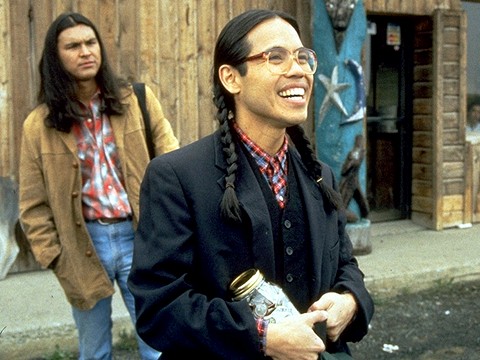
     This week in class we watched Smoke Signals. I enjoyed the movie but I honestly thought it was a little cheesy. I really enjoyed the whole story and I was happy that Victor Joseph had healed but it was just very predictable. I thought the movie was humorous and entertaining while being educational about native life. I did not always understand the message that Thomas Builds-the-Fire was trying to convey through his stories. Overall, I thought it was a good movie. I also drew a lot of parallels between the movie and Ceremony. For example, alcoholism, PTS, and healing.
     This week we were also introduced our essay prompt for out Native Study Essay. I am anxious to write my essay and see more in depth how everything we have studied links together. I am nervous about writing it as well because the prompt is challenging and I have a busy week ahead of me with work and other classes. I really enjoyed this unit of native study as it was not something I had been exposed to. I think it will be fun to analyze and write about. I am also glad to be exploring new topics.
  

Monday, March 10, 2014

Reflection Week 3/3

     The end of Ceremony was devastating. It was hard for me to read when Tayo was tired, hungry, and thirsty and he was running from his friends. That was unbelievable to me and I can't imagine the heartache he felt when he found out that they were hunting them down. Then, I could not bear to read the part when Emo, Pinkie, and Leroy were beating Harley and Tayo had to watch. I am still confused on exactly what happened then though and how Tayo made it back home safely. I could feel how hard it was for Tayo to watch but afterwards I couldn't read his emotions. I couldn't tell if he was still finding light in his days or if he was depressed again.
     Something I noticed in the last section of the book was the use of the color yellow. It was used repeatedly to describe a wide variety of things. For example, the bull, the bull's eyes, the sandrock, flames, the light, the sand, uranium, and the leaves. Not only were all these things described as yellow but the same items using the same description were repeated over and over in this section. In fact, there were many things described with color in this section but yellow especially stood out to me. I don't understand why this is used so much and why it is relevant. 
This represents Harley's hand-a symbol for Harley. He was bleeding badly when Tayo last saw him and the heart represents Tayo and Harley's love for each other.
This is the yellow, and yellow light, that is surrounding Tayo throughout this section of the novel.


Monday, March 3, 2014

Reflection Week 2/24

    The essays this week were hard for me because they were before we discussed and I was confused on a lot of the reading material. After we discussed, I understood that I analyzed the section incorrectly. I felt like Tayo started healing through the ceremonies and stories that Betonie told him. I felt like he was finally becoming happy and starting feel like he could let go of some of his sadness or at least control it. Then when he came down and spent time with Harley, Leroy, and Helen Jean I felt that he was relapsing. He started drinking again to numb himself and it seemed to me that he enjoyed that. Now I know that Tayo was realizing that he no longer wanted to feel that way and live his life that way.
    I am very glad to see that Tayo has continued healing, that I was wrong in my analyzation. The discussion we had after the essays really helped me better analyze portions of the reading and I can now see that Tayo was still healing. He was relapsing in a way but during that he knew it wasn't what he was going to continue to do. Also, now that we are farther in the reading it is so apparent that Tayo is way healthier. I am so happy for Tayo and it is such a relief to see him feel and react like a healthy person. I feel his happiness when he smiles and it is contagious. It is amazing what Tayo has overcome. 

This picture represents Tayo and his relief/release from his sadness.